Research
(8) Tunable Coatings on Various Substrates for Self-Adaptive Energy Harvesting with Daytime Solar Heating and Nighttime Radiative Cooling
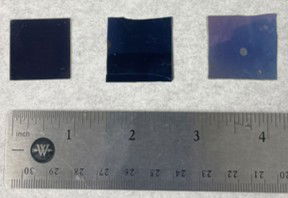
In this work, tunable vanadium dioxide (VO2) metafilms on different substrate materials fabricated via low-oxygen furnace oxidation are demonstrated for self-adaptive daytime solar heating and nighttime radiative cooling. Because of its thermally-driven insulator-to-metal phase transition behavior, the VO2 metafilms work as a spectrally-selective solar absorber with a high solar absorptance of 0.86 and a low infrared emissivity of ≈0.2 at daytime, while they behave as a selective cooler at nighttime to dissipate heat effectively through the atmospheric transparency window with a high emissivity of ≈0.76 to cold outer space. From the outdoor vacuum tests, a significant temperature rise up to 169 K upon solar heating and a temperature drop of 17 K at night are experimentally observed from these tunable VO2 metafilms. With effective atmospheric temperature fitted in situ, the accurate heat transfer model shows excellent agreement with the stagnation temperature measurement, indicating a high heating power of ≈400 W m−2 at 80 °C sample temperature in the middle of the day, and a cooling power of ≈60 W m−2 at 30 °C in equilibrium with the ambient at night. This work would facilitate the development of self-adaptive coatings with cost-effective and scalable fabrication approaches for all-day energy harvesting.
Read More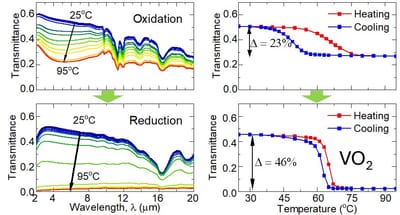
(7) Maximizing Infrared Transmission Contrast upon Phase Transition of Thermally Grown Vanadium Dioxide Thin Films by Rapid Thermal Processing
Pristine vanadium dioxide (VO2), an insulator-to-metal transition (IMT) material, is grown via furnace oxidation followed by rapid thermal annealing with forming gas (5% H2/95% N2) which reduces surface over-oxides such as V2O5 formed during the oxidation. The evolutional IMT behaviors of the thermochromic film and vanadium oxide states over different reduction times are systematically studied with temperature-dependent infrared spectrometry, electrical resistivity, and X-ray diffraction measurements. After optimally reducing surface over-oxides to VO2, infrared transmission contrast upon phase transition is enhanced to 46% (at 9 μm wavelength) compared to 23% from full oxidation without any reduction. Moreover, the pristine VO2 thin film obtained from thermal oxidation and optimal reduction processes exhibits sharp phase transition and narrow thermal hysteresis within 2–4 °C in both infrared transmission and electrical resistivity, which are comparable to the best quality VO2 prepared by other sophisticated fabrication techniques. The thermally grown method presented here would facilitate the scalable fabrication of high-quality VO2 thin films and tunable radiative coatings for high-performance thermal control applications.
Read More
(6) Resonant-mode metasurface thermal super mirror by deep learning-assisted optimization algorithmsRelease
A “super-mirror” having ultrahigh infrared reflectance is achieved by an optimized photonic contrast grating metasurface. Finding ways to achieve this exceptional performance can be enabled by implementing global optimization and machine learning elements, such as Bayesian optimization and genetic algorithm. Here, we acquired an optimized grating design made of high-index germanium, which excites resonances that result in ultralow emittance at certain wavelengths. Our optimizations assisted in the discovery of hybridized coupling of Fabry-Pérot modes and guided modes in a monolithic microscale multilayered coating. We demonstrate constraints in the given geometric variable ranges improves the overall performance of algorithms. We also show the enhanced performance of a deep learning Feedforward Neural Network, which is implemented as the inverse design using the network trained with dataset obtained from Bayesian optimization and Genetic Algorithm approaches. The performance of the Feedforward Neural Network-assisted design produced normal emissivity difference by only +3.5 %, with lower sensitivity to grating dimensional parameter variations. The improvement is achieved by predicting and better understanding of the optical physics of resonant gratings. The proposed few-layer grating coating can be applied to space components, enclosures, and vessels to suppress thermal radiative heat loss.
Read More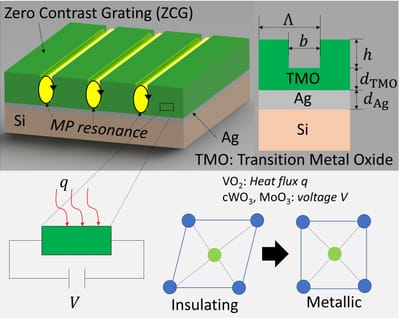
(5) Infrared radiative switching with thermally and electrically tunable transition metal oxides-based plasmonic grating
Plasmonic and phase transition has been blended to gain the infrared radiative switching which is tunable with temperature or voltage supply. This is applied via vanadium dioxide, tungsten trioxide, and molybdenum trioxide as transition metal oxides (TMO). The metallic phase at high temperature or colored state contributes in magnetic polariton (MP) excitation, producing broad absorptance. The TMO-based sub-layer is integrated underneath the grating fully supporting MP resonance. In contrast, this underlayer leads to producing the narrowband absorptance originated from concept of zero contrast grating (ZCG). The zero gradient in refractive index at the output plane of the grating cause transmission of light in broad wavelength range. With introduction of reflective silver underlayer, those transmitted through the grating are reflected back. However, there exists the near-zero narrowband transmission peaks in ZCG. This undergoes transformation to narrowband absorptance. In addition, another absorptance peak can be induced due to phonon modes at insulating phase. The MP resonance at metallic phase is characterized with inductor-capacitor (LC) circuit and the narrowband absorptance peaks are characterized with phase shift from the Fabry–Perot round trip (FP-RT) eigenequation from high contrast grating (HCG). The work expands the usage of transition metal oxides in infrared region with larger contrast.
Read More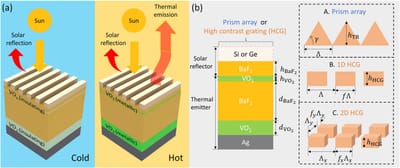
(4) Simultaneous solar rejection and infrared emission switching using an integrated dielectrics-on-VO2 metasurface
Passive infrared emittance switching can be achieved with a metal-to-insulating phase transition material vanadium dioxide (VO2), but its non-transitioning bandgap results in high absorptance in the visible wavelength range. To achieve a half-order reduction of absorptance in the visible to near-infrared region, we design integrated dielectric photonic metasurface structures on monolithic VO2 coatings. This combination of nano/micro-patterned dielectric diffractive and resonant gratings with a multilayer VO2 structure preserves the terrestrial thermal wavelength emission switching capabilities. We demonstrate a periodic microscale diffractive prism array, comparing the reflectance provided by either infrared-transparent germanium (Ge) or silicon (Si). Despite the advantage of total internal reflection in the broad near-infrared region, some bandgap absorption limits the performance in the visible wavelengths. A better theoretical means to reflect broadband light via waveguide-like Fabry–Pérot resonance are near-wavelength 1D and 2D High Contrast Grating (HCG) high-index metasurface structures surrounded by a low-index host medium. This HCG metasurface allows broadband high-quality reflection within the dual-mode (or tri-mode) region from 1.0 to 2.2 µm wavelengths for HCG with a refractive index of 4.0, which corresponds to Ge. This study investigates the advantages and disadvantages along with the thermal performance of these metasurface augments aimed to enable thermally switchable passive radiative cooling—thermal emission exceeding solar absorption—of solar cells, terrestrial buildings, and energy storage devices.
Read More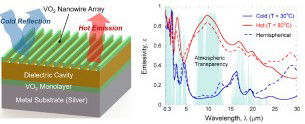
(3) An optimized self-adaptive thermal radiation turn-down coating with vanadium dioxide nanowire array
Insulator-to-metal temperature phase transition Vanadium Dioxide (VO2) can enable radiative property switching in the mid- to far-infrared wavelengths. With computational optimization of grating arrangement and layer thickness parameters, we identify a monolithic high-performance turn-down thermal emittance coating of no more than 2 μm thick, consisting of a VO2 sub-wavelength nanowire grating array on an index-matched Fabry-Perot dielectric thin film on an additional absorbing VO2 sublayer. The working principles of this optimized VO2 structure are its gradient refractive index allowing high through-coating transmittance in the cold state, and its near-unity emissivity from semi-metal-insulator-metal plasmonic coupling in the hot state. This anisotropic patterned structure also considers performance over polarized incident light. A survey of other Fabry-Perot cavity materials with refractive index matching points to higher turn-down performances given an optimal VO2 nanowire volume filling ratio. With 24-hour solar and environmental analysis in comparison to other VO2 metasurfaces and multilayers, this coating enables responsive passive radiative cooling at high temperatures exceeding transition. This nano/micro-patterned coating could potentially impact self-cooling of the solar cells, batteries, and electrical devices where risk presents at high temperatures.
Read More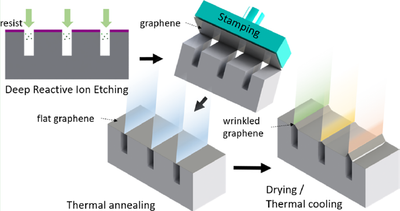
(2) Mechano-optical resonant emission by edge angle modulation of wrinkled graphene on plasmonic metal gratings
Graphene coated on top of photonic-plasmonic metasurfaces can produce resonant radiative emission in the mid-infrared region. Narrowband emission peaks are observed through folding graphene into “origami” ridges over metal grating grooves, creating a complementary cavity mode above the trench. This geometrically tuned phenomenon of graphene surface plasmon excitation along the folded sheet enhances the emission when added to magnetic polariton (MP) resonance induced within the plasmonic grating groove. Our analytical models describe how this graphene surface plasmon polariton (SPPG) is a function of folded graphene geometric parameters, and most importantly, the graphene edge angle that distends from the grating surface. The frequency-dependent phase shift of SPPG is fitted to grating parameters, and a modified inductor-capacitor circuit model was developed for predicting MP resonance mode with graphene influence. It was found that the edge angle of wrinkled graphene blue-shifts the groove MP resonance and SPPG resonant emission peak in both wrinkled graphene alone and with the grating substrate. The understanding of geometrically modulated graphene adhered on plasmonic gratings impacts the design and capability of narrowband cavity emitters and contributes toward the development of mechanical-optical environmental sensors.
Read More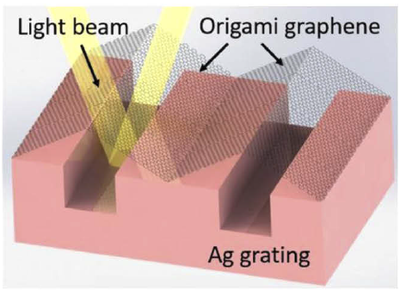
(1) Plasmon-resonance emission tailoring of “origami” graphene-covered photonic gratings
Due to the negative coefficient of thermal expansion of graphene, temperature changes of graphene-coated photonic surfaces could induce resonant mode shifts in diffractive optical absorptance and emission. This study focuses on the modification of optical properties through folding, or “origami,” of graphene covering a plasmonic metal channel grating. This work is especially critical to understanding tailored deep plasmon emission from geometrically-modulated conducting sheets such as graphene. Conformational changes in graphene on gratings are found to tailor cavity resonance emission and plasmonic oscillations such as magnetic polaritons (MPs) and surface plasmon polaritons (SPPs), respectively. Up to 46% reduction in radiative absorptance was observed through retarded MP. Excited SPP modes can increase narrowband absorptance of 0.5 through folding of graphene. Tailoring of optical absorptance can be used for applications such as photodetectors and thermal emitters.
Read More